Thursday, June 11, 2020

THE "GHOST LIGHTS" OF BROADWAY AND OTHER THEATRICAL SUPERSTITIONS©

Broadway theatres and Broadway performing companies are having a tough time right now during the COVID-19 pandemic, as are the performing arts in general.  Shows scheduled for the 2020-2021 Season have been indefinitely put on hold, and Broadway theatres recently announced that they would remain closed, or "go dark", for the rest of 2020.

But Broadway theatres never truly completely "go dark", because for over 100 years, since the late 1800s, one light has remained on inside each of the theatres -- the "Ghost Light".

Simply put, the Ghost Light is a single, unadorned light bulb on a stand placed "downstage center" on an open stage and is turned on while the theatre is empty;  however, it symbolizes so much more than being on for safety reasons to keep the actors and backstage crew from tripping in the dark and falling into the orchestra pit.

Ghost Lights have even had their own "Broadway moments", sharing the stage solo with Tony-award winner Andre de Shields in his Broadway debut in "The Wiz" back in 1974, and again sharing the stage solo with 3-time Tony-award winner Bernadette Peters in 2003 in the Broadway revival of the musical "Gypsy".

According to theatre scholar James Fisher, the exact origins of the Ghost Light is murky, although there are some popular theories. He writes in Historical Dictionary of American Theater: Beginnings that the "ghost light comes from the days of gas-lit theatres and refers to dimly lit gaslights used to relieve pressure on gas valves”.

In another of Fisher's books, The A to Z of American Theater: Modernism,  he relates a popular legend that a burglar once snuck into a Broadway theater, fell from the darkened stage, broke his leg, and then sued the theater.

However, the most pervasive belief is that the Ghost Light will either ward off ghosts or distract them -- and even some guided ghost tours of several of Broadway's historic theatres focus on that belief.

A special feature article by Lindsey Wilson in a 2008 issue of Playbill pointed out that theatrical folk historically are a superstitious lot.  Wishing actors a broken leg (don't ever tell them "good luck"), avoiding whistling backstage (it used to confuse the stagehands), and being careful not to say the word  "Mac . . . . ."  (instead, referring to it as "The Scottish Play" because they believe that it is "cursed"), are just a sampling of the multitude of long-standing theatre traditions.

Other "theatrical stage superstitions" hold that Ghost Lights provide opportunities for ghosts who are "former actors" to perform onstage, thus appeasing them and preventing them from cursing the theater or sabotaging the set or the production.  The Ghost Light is supposed to give them enough light to perform on stage -- AND it is also considered bad luck not to allow these "late thespians" to do this at least once a week -- giving rise to the "legendary" reason why theatres usually only schedule productions for the public 6 days per week.

As for the theatre ghosts themselves, there is no shortage of "ghost sightings" among the legends which accompany many of Broadway's historic theatres and give support to this superstition.  Olive Thomas, for example, a former Ziegfeld showgirl who died in 1920, is a "resident"  at The New Amsterdam Theatre where she regularly performed during her lifetime.  She is often sighted by theatre-goers, blowing kisses to them as they leave the theatre after a present-day performance.

Even if after-hours lighting weren't required for safety purposes, superstitious theatre folk would probably still insist on keeping the Ghost Light burning.   The business of mounting a theatrical stage production for Broadway is risky enough without an irritable spirit or two lurking in the wings -- not unlike one of the most famous -- or infamous -- real or fictional -- of these "spirits" whose initials are "O.G."  (Opera Ghost) -- better known as "The Phantom of the Opera".

©2020 Snobby Tours®, Inc.  All Rights Reserved.

Wednesday, June 3, 2020

RECENT DISCOVERIES OF ANCIENT MAYAN STRUCTURES IN MEXICO©

Archaeologists and historians have long been interested in the Mayan Civilization in present day Mexico.  Mayan settlements date back approximately 4,000 years to 2000 BCE, when small farming communities began to appear.  During the 500-year time span from 1500 BCE to 1000 BCE, Mayan culture developed, along with larger settlements.

Recently, scientists using an aerial remote-sensing method, discovered a gigantic rectangular elevated platform built between 1000 BCE and 800 BCE in the Tabasco State of Mexico.

Unlike the famous Mayan pyramids constructed much later between 500 CE and 700 CE in Mexican and Guatemalan cities, this very early structure was built with clay and earth rather than stone used in the later structures.  Researchers speculate that this newly-discovered structure was likely used for mass rituals and special occasions, such as celebrations of calendar cycles, because jade axes were found near the center of the structure's highest plateau.

Located at a site called Aguada Fenix, near the Guatemalan border, the structure is approximately 1/4-mile wide, almost 1-mile long, and stood between 30 and 50 feet high. 

What is remarkable is that in total volume, this structure exceeded Ancient Egypt's Great Pyramid of Giza which was completed around 2560 BCE -- over 1,500 years earlier.

This most recent Mayan discovery comes just a few years after scientists in 2013 found an entire ancient Mayan city consisting of 15 pyramids --  one of which was 75-feet tall -- ball courts, plazas and several sculpted stone shafts called stelae.  The presence of multiple ball game courts indicates that the site was a very important city.


The city had remained hidden for centuries in the rain forests of eastern Mexico.  The scientific team named the city Chactun, meaning "Red Rock" or "Large Rock".  They estimated that the city could have been home to as many as 40,000 people, and likely flourished during the Late Classical Period of Mayan Civilization between 600 CE and 900 CE.

The site, which encompasses around 54-acres, is one of the largest found in the Yucatan's central lowlands,  now entirely covered by the jungle.  It was likely abandoned around 1000 CE due to multiple factors, including climate change and wars between the competing regions of the Mayan Empire during that time frame.

The Mayan Civilization was one of the most advanced in the pre-Columbian Americas.  At its peak, its rule extended over much of modern-day Mexico, and included large portions of the Yucatan, Belize, Guatemala, and Honduras. 


(Sources: Will Dunham, Reuters, June 3, 2020;  Luc Cohen, Reuters, June 20, 2013.)

©2020 Snobby Tours®, Inc.  All Rights Reserved.


Friday, May 22, 2020

LOCATIONS FEATURED IN THE "MIDSOMER MURDERS" TV SERIES©

This much-loved British TV series for over 20 years is currently seen worldwide in over 200 countries. The love affair with this intriguing murder mystery series is not at all surprising.  Fans of the long-running 'Midsomer Murders' are treated to weekly "whodunits" presented in a perfect combination of drama, dark humour, clever well-written stories, interesting characters and some very outrageous methods of "doing someone in", such as by being shot at by catapulted bottles of wine, drowning in a silo of fermenting beer or being crushed by heavy rounds of aging cheese -- all set in the beautiful British countryside in South Oxfordshire -- and often accompanied by visits to the local pub for "a pint" or having a cup of tea served in fine china in the drawing room of a manor house.  From local pubs to village greens, and from churchyards to country manors and estates, here are a few fan favourite locations.

MAPLEDURHAM HOUSE.   A  murder mystery can benefit from having a country house, and Mapleduram House is a perfect setting. Still a family residence to this day, it has appeared in several episodes of "Midsomer Murders" over the years in various guises, including as a health spa.  It has several buildings on site, some dating back nearly 400 years, including the last commercially-working watermill on the River Thames. 

CHINNOR.  Various areas in and around Chinnor, including the Railway Station, have been used as locations in "Midsomer Murders", most particularly in the episodes entitled "The Made to  Measure Murders" and "Death in a Chocolate Box".   Parts of St. Andrews Church in Chinnor (pictured here) date back to the 12th and 13th Centuries. Historic records reveal references to Chinnor going even further to King Edward the Confessor, a Saxon who ruled England during the 11th Century from 1042 until the Norman Conquest in 1066.


WARBOROUGH.  Warborough is home to seven locations that appear in the "Midsomer Murders" TV series. Villages in the South Oxfordshire part of England often have a village green on which cricket matches, annual fetes and historical reenactments are held, and also generally have a cozy local pub which is a regular meeting place for locals.

LONG CRENDON.  Filled with an abundance of thatch-roofed cottages along its famous High Street and a 15th century courthouse, Long Crendon has been featured numerous times in "Midsomer Murders".  Long Crendon or simply Crendon, as it was known in the Middle Ages, has a long archaeological history. At Church End a concentration of artifacts from the Iron Age, Roman and Saxon periods have been unearthed.  The Courthouse near the Church dates from about 1485 and provided accommodation on the ground floor for the poor and on the upper floor for the meetings of the manorial court. 

"Midsomer Murders" currently in its 21st Season, has amassed literally legions of fans, created enormous tourism interest in South Oxfordshire to walk in the intrepid footsteps of DCI Tom Barnaby and later on in the series, in the footsteps of his very capable cousin from Brighton, DCI John Barnaby, and has made "household names" of many of the heretofore "only primarily known in Britain" actors.  Viewers who are diehard fans immensely enjoyed "Sykes", often fondly called "Syksie", the terrier-mix who barked in his retirement notice and hung up his leash back in 2016 after being a "scene stealer" and a bit of comic relief for several Seasons as DCI John Barnaby's family dog.  

Although the idyllic villages in "Midsomer Murders" have fictional names, it only takes a little bit of sleuthing on the internet to find the actual locations to visit and to have a pint at the local pub or to take a guided tour of a local manor house. 

For more photos of memorable and popular locations from "Midsomer Murders", link to: https://www.visitbritain.com/gb/en/top-10-midsomer-murders-locations for Mark Pawlak's article of March 26, 2019.

©2020 Snobby Tours®, Inc.  All Rights Reserved.

Monday, May 11, 2020

THE ARCHITECTURE OF THE KIMBELL ART MUSEUM in FT. WORTH, TEXAS©

Exhibit Space:  Louis Kahn Building
Exterior: Renzo Piano Pavilion


The Kimbell Art Museum officially opened on October 4, 1972. 


The Kimbell Art Foundation which owns and operates the Museum had been established in 1936 by Kay and Velma Kimbell, together with Kay’s sister and her husband, Dr. and Mrs. Coleman Carter. 


Early on, the Foundation collected mostly British and French portraits of the eighteenth and nineteenth centuries.

"The Kimbell", as the Museum is fondly known, consists of two separate buildings, each designed and constructed during different decades by different world-renowned architects, namely Louis Kahn and Renzo Piano.  

The Kimbell Art Museum’s original building designed by Louis I. Kahn has become a mecca of modern architecture. Kahn designed a building in which “light is the theme.” Natural light enters through narrow plexiglass skylights along the top of cycloid barrel vaults and is diffused by wing-shaped pierced-aluminum reflectors that hang below.  

Surrounded by elms and red oaks, Renzo Piano’s colonnaded pavilion, completed in 2013,  stands as an expression of simplicity and lightness—glass, concrete, and wood—some sixty-five yards across the tree-lined pathway to the west of Louis I. Kahn’s signature cycloid-­vaulted museum of 1972.   

For more information about each of the two Exhibition spaces at The Kimbell, visit the  Museum's  Website at: https://www.kimbellart.org/art-architecture/architecture


©2020 Snobby Tours®, Inc.  All Rights Reserved.

Thursday, January 12, 2017

ENTERING CHARLIE CHAPLIN'S WORLD©

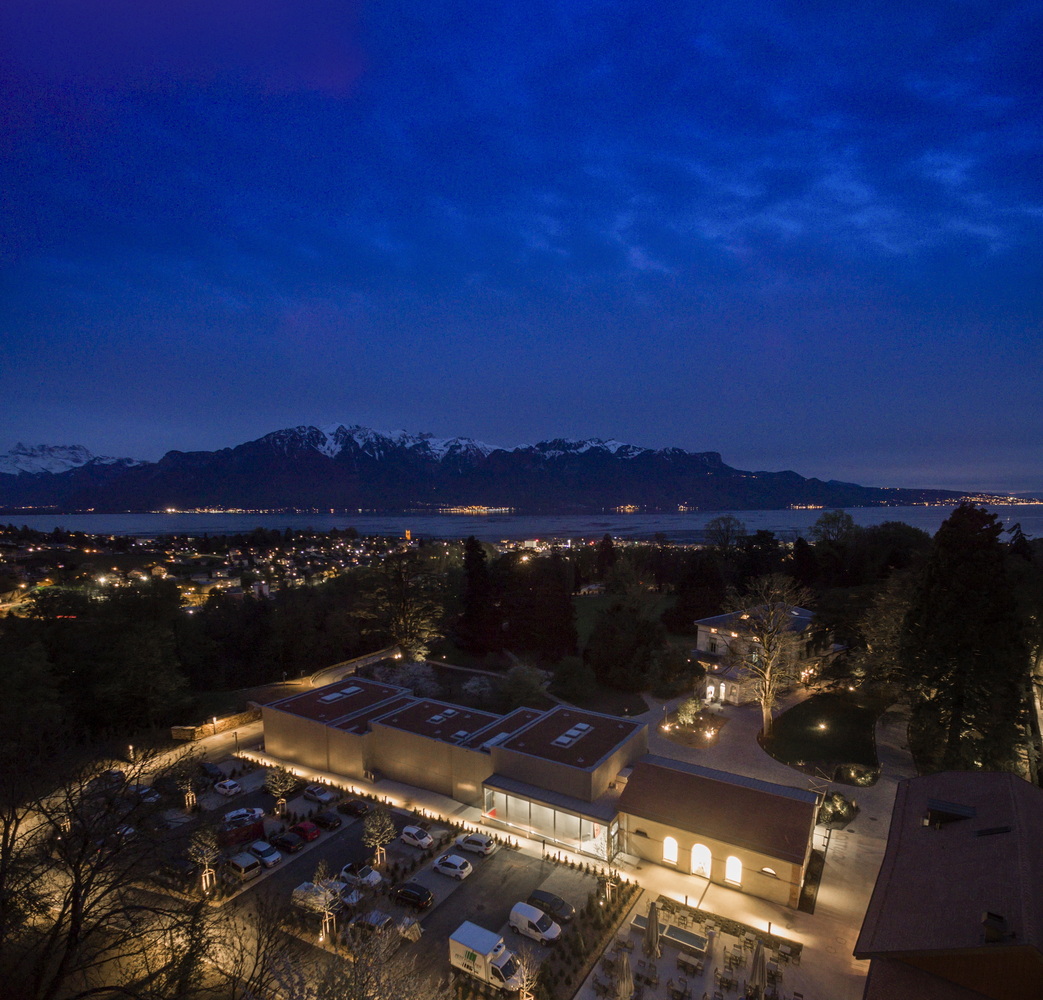
A most enchanting place near Lake Geneva in Corsier-sur-Vevey, Switzerland opened to the public in April 2016, and people from all over the world have been flocking to see it -- Charlie Chaplin's World, a museum consisting of several buildings including Chaplin's residence Manoir de Ban, dedicated to the personal and family life, and to the public life and career, of the cinematographic genius Charlie Chaplin. 


With the assistance of Michael Chaplin and Eugene Chaplin, two of Chaplin's eight children born to him and his wife, Oona O'Neill, his home on a 10-acre estate amid nature and having spectacular views of Lake Geneva and the Alps, has become the centerpiece of the Museum complex.


Over a 15-year period, commencing in 2001, Chaplin's extensive collection of movie props and costumes, photographs, manuscripts, and other artifacts from Chaplin's long life and career were meticulously curated.   Manoir de Ban, as his residence on the estate is called and where he lived for over 25 years until his death at age 88 in 1977, was refurbished, and separate structures which include an interactive "museum of his films", were constructed.  


© Fernando Guerra | FG+SG

The property was originally farm land until 1839, at which time the Neo-Classical manor house was built.  It was purchased by Chaplin in 1952.  On the estate grounds is also a park, an orchard, and terraced forest land which was at one time a vineyard typical of this region of Switzerland.


The end result of 15-years of planning and preparation is, in a word, outstanding -- and beautifully captured in the attached photographic article published by ArchDaily on July 25, 2016, which retains all copyrights therein.  http://www.archdaily.com/791871/charlie-chaplin-museum-itten-plus-brechbuhl


Because we are so impressed with Charlie Chaplin's World, Snobby Tours®, Inc.'s international heritage tour planning division, International Heritage-Inspired Tours by Snobby Tours®, Inc., has custom-created a Tour around it entitled  "Chocolate, Cheese, Castles and Charlie Chaplin's World in the Lake Geneva Region of Switzerland"©   For more information, visit our Website at:  http://www.snobbytours.com/Internationaltours.html


© 2017 Snobby Tours®, Inc.  All Rights Reserved.

Monday, March 21, 2016

CRYSTAL BRIDGES MUSEUM OF AMERICAN ART'S RECONSTRUCTION OF THE FRANK LLOYD WRIGHT-DESIGNED BACHMAN-WILSON HOUSE COMPLETED AND OPEN TO THE PUBLIC©

CRYSTAL BRIDGES MUSEUM

Located in the southern region of the Ozark Mountains in Bentonville, Arkansas, Crystal Bridges Museum of American Art, founded by Alice Walton whose father Sam Walton created the Walmart stores, explores the continuously unfolding history of America through collecting and exhibiting outstanding works of art that illuminate the American artistic heritage which enriches the understanding and appreciation of American history and culture.

Set on 120 acres of native Ozark forest, with 3.5 miles of included walking trails, Crystal Bridges’ grounds are surrounded by an environment which enhances the “museum experience”.  The Museum’s breathtaking and distinctive architecture designed by internationally renowned architect Moshe Saftie incorporates the topographical elements, immersing visitors in the landscape.


To this picturesque setting recently has been added the Bachman-Wilson House, designed by architect Frank Lloyd Wright who was known throughout his career for creating structures which incorporate and showcase the surrounding natural environment.


BACHMAN-WILSON HOUSE

In 1954, architect Frank Lloyd Wright designed a house in the “Usonian” style along the Millstone River in New Jersey for Gloria Bachman Wilson and Abraham Wilson.  

The word “Usonian” was derived from an abbreviation of “United States of North America”.  Wright embraced this term as the name
for a distinctly American and “democratic” style of residential architecture which he had developed during the Great Depression.  Compared to his highly customized homes, these were simpler, lower-cost houses designed to be within the reach of the average middle-class American family, without sacrificing quality.  Approximately 120 Usonian homes were built.


Known as the Bachman-Wilson House for the Wilsons and also Gloria Wilson's brother, Marvin Bachman who was an apprentice to Wright, the house was subsequently purchased by architect/designer team Lawrence and Sharon Tarantino in 1988 and meticulously restored. Over the years, however, the structure was threatened by repeated flooding at its original location, and the Tarantinos eventually determined that selling the house to an institution willing to relocate it would be the best option for its preservation. After the Tarantino's multi-year search for a suitable institution, they settled upon Crystal Bridges, which acquired the house in 2013. The entire structure was then taken apart and each component was labeled, packed, and loaded into two trucks for transportation to the Museum. After its 1,235 mile journey, the Bachman-Wilson House arrived at the Crystal Bridges site in April, 2014. 

After the arrival of the de-constructed house, Crystal Bridges embarked upon more than a year of painstaking re-construction, including adding an improved climate-control system which better protects the extensive mahogany wood within the house, the Bachman-Wilson House opened to the public in November, 2015 at Crystal Bridges.


Crystal Bridges is included on our "Presidential Libraries and Fall Foliage of the Midwest"© Tour.  For more information about this Tour and upcoming Tour Dates, link to our Website at:  snobbytours.com/PrezLibMidwestFFChicago.html

(Primary Source information and Video materials courtesy of Crystal Bridges Museum of American Art which retains all copyrights therein.)

©2016 Snobby Tours®, Inc.  All Rights Reserved.


Tuesday, July 28, 2015

ABRAHAM LINCOLN PRESIDENTIAL MUSEUM CELEBRATES ITS 10th YEAR and the 150th ANNIVERSARY OF THE END OF THE WAR BETWEEN THE STATES©

2015 is a landmark year for the Abraham Lincoln Presidential Museum and Library.

Opened in 2005, it is located in the historic downtown area of Springfield, Illinois, and is considered to be the first major "experience museum because it combines priceless historical artifacts with innovative, contemporary storytelling technology.  The result is an engaging, emotional, and educational experience which makes visitors feel as if they are in there themselves, in the same place.      

Lincoln Presidential Museum
Lincoln Presidential Library


The Library is a research facility and rare book collection focusing on Lincoln's life and the American Civil War.  The Museum directly across the street features two major galleries, each off the massive rotunda, representative of two different stages of Lincoln's life. 

One gallery, entitled "Journey One: The Pre-Presidential Years", commences inside a log cabin, and then winds through a series of rooms depicting Lincoln's early life in and around Springfield.

The second gallery, entitled "Journey Two:  The Presidential Years", commences through a re-created entry to the White House, and covers Lincoln's Presidential years, and the Civil War period thru his assassination.

Both contain life-size dioramas of settings of key events in Lincoln's life.  Original artifacts and other memorabilia are changed from time to time, but the collection usually includes the original handwritten Gettysburg Address, a signed Emancipation Proclamation, Lincoln's reading glasses, Mary Todd Lincoln's White House china, and her wedding dress.

Additionally, there are theatre presentations with live as well as holographic characters from Lincoln's life and times.

In celebration of its 10th anniversary in 2015, the Lincoln Museum is featuring several Special Exhibitions.

"A Decade Ago" is a reflective look back at the creation of the Museum and its dedication.  On view are objects, images, and video that tell the story of how the Lincoln Presidential Museum was created.

"Undying Words:  Lincoln 1858-1865" is an all-new exhibit, in collaboration with the Chicago History Museum.  It features original versions of Lincoln's most famous speeches, plus Lincoln and Mary's carriage, his death-bed, a 7-foot tall "Rail Splitter portrait, and several interactives.

The Abraham Lincoln Presidential Museum and Library are one of five Presidential Museums and Libraries included on our "Presidential Libraries and Fall Foliage of the Midwest©"  custom-created heritage Tour.  Other Presidential Libraries included on this Tour are Hoover, Eisenhower, Truman and Clinton.   For more information, link to:  http://www.snobbytours.com/PrezLibMidwestFFChicago.html

©2015 Snobby Tours®, Inc.  All Rights Reserved.